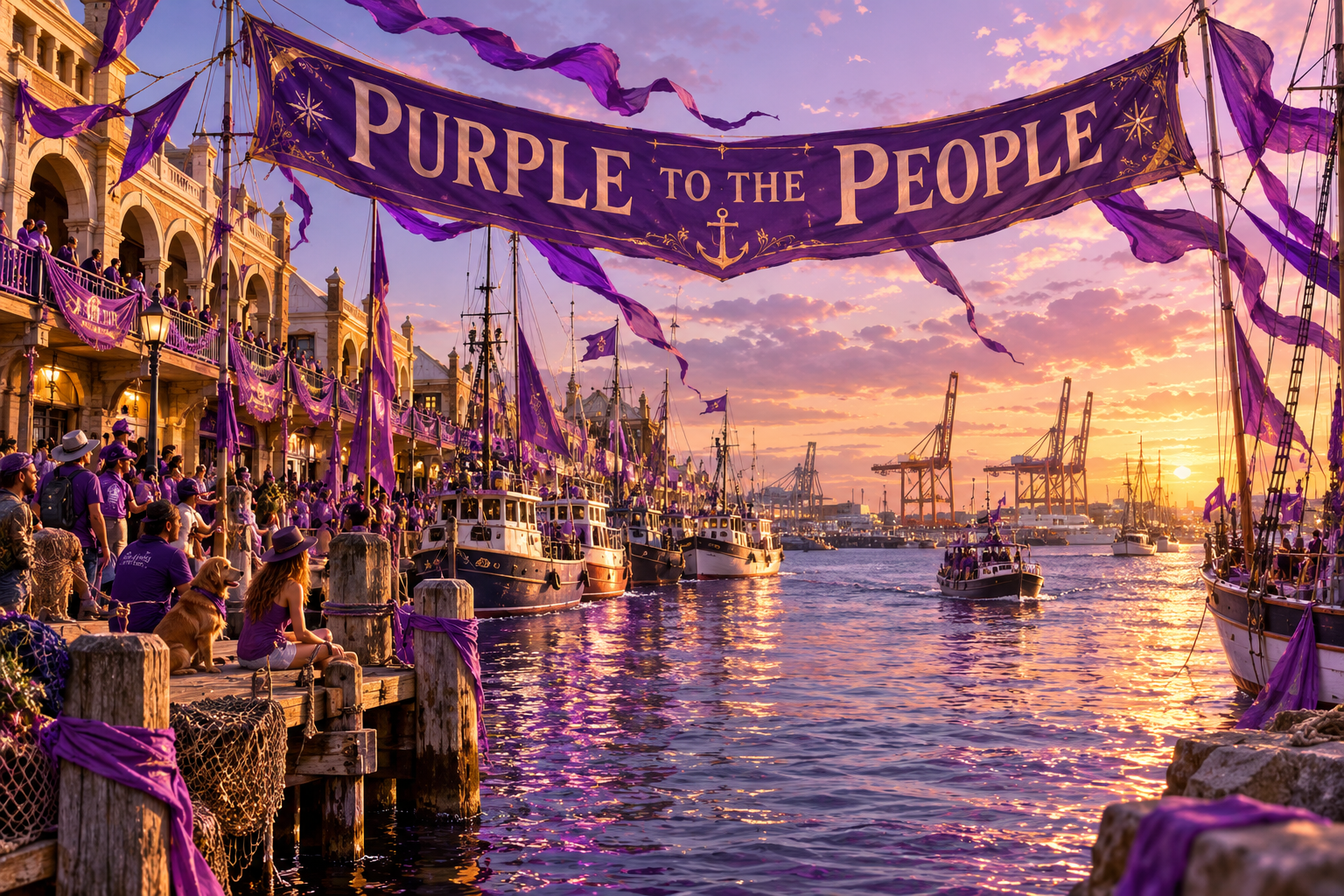
Fremantle has turned purple.
Purple flags.
Purple scarves.
Purple shopfronts.
Purple houses.
Children in purple.
Grandparents in purple.
Footballers in purple.
An old working port on the edge of the Indian Ocean has dressed herself for the occasion.
And Madame ponders…
How did the colour of emperors end up belonging to the Dockers?
Long before synthetic dyes made purple something any of us could wear, true purple pigment was extraordinarily difficult and expensive to produce.
The famous Tyrian purple of the ancient Mediterranean came from tiny sea snails.
From the sea came a colour so precious that human beings wrapped it around power.
Purple became associated with rulers, wealth, rank, ceremony and sacred authority.
A colour used to distinguish one body from another.
This one elevated.
That one ordinary.
This one crowned.
That one beneath him.
And then Madame looks around Fremantle.
Everybody is beautifully dressed in purple.
There is something wonderfully irreverent about it.
Because Fremantle did not name its football club after kings.
Or emperors.
Or conquerors.
They named them after workers.
Dockers.
People beside the water.
People who hauled.
Lifted.
Loaded.
Unloaded.
Built.
Repaired.
People whose bodies did the hard physical work that allowed ships to enter the harbour, exchange their cargo and sail again.
Much of history remembers the people standing on balconies.
Far less often does it remember the people who built the balcony.
But Fremantle put the workers in the name.
And then dressed them in purple.
There is another little rebellion hidden inside the colour.
Purple was not simply bestowed upon Fremantle.
The club chose it.
When purple was proposed instead of royal blue, the authorities were unconvinced.
Fremantle persisted.
The purple stayed.
And over time, something once unusual became inseparable from the city's identity.
Purple was not bestowed upon Fremantle. Fremantle chose purple.
Madame likes this very much.
Because sovereignty does not need to be bestowed either.
We do not need somebody standing above us to announce that we have finally become worthy.
We do not require permission to inhabit ourselves.
We do not need another human being to place a crown upon our heads.
We can crown ourselves.
And perhaps that is why purple belongs so beautifully inside the YONIverse too.
Purple at the crown.
Purple as consciousness.
Purple as sovereignty.
Purple as connection to something larger than the hierarchies human beings have constructed between ourselves.
Because what if sovereignty was never about standing above another person?
What if it meant standing fully within oneself?
Then nobody needs to lose their crown for somebody else to wear one.
There is enough purple for everybody.
And perhaps the loveliest irony of all is this:
Purple belonged to the sea before it ever belonged to kings.
Human beings gave it rank.
Human beings gave it hierarchy.
Human beings decided who could wear it.
But the sea was making purple long before an emperor wrapped himself in it.
And now, thousands of years later, beside another sea, purple has spilled out into the streets of a working port.
Onto balconies.
Into windows.
Around shoulders.
Across faces.
Onto children.
Onto workers.
Onto footballers running onto a field carrying the name Dockers.
The colour has come down from the throne.
Or perhaps it was never truly on the throne at all.
Perhaps we simply forgot where it came from.
Madame looks toward the Indian Ocean and smiles.
No one needs to stand beneath another.
No one needs to surrender their own sovereignty so that somebody else may possess theirs.
The sea has enough purple for us all.
Purple to the workers. Purple to the children. Purple to the elders. Purple to the artists. Purple to the labourers. Purple to anyone who was ever told that sovereignty belonged somewhere above them. Purple to the people.